

Yes, there are summer camps well-suited to kids with ADHD or autism — both specialized programs designed specifically around neurodivergent needs, and mainstream camps with dedicated inclusion staff and smaller group ratios that can support a wide range of campers. The right fit depends less on a diagnosis alone and more on a specific child’s support needs, sensory sensitivities, and social comfort level, which is why it’s worth evaluating camps on a few concrete criteria rather than a generic “best camps” list.
This guide walks through what to actually look for, the honest tradeoffs between specialized and mainstream programs, and the questions worth asking before you enroll.
Specialized Camps vs. Mainstream Camps with Inclusion Support
Specialized camps are built from the ground up around neurodivergent campers — staff are trained specifically in ADHD, autism, and related support strategies, activity schedules are often more structured and predictable, and group sizes tend to be smaller. Some specialize further, focusing specifically on social-cognitive skill-building, sensory-friendly programming, or a particular support level.
Mainstream camps with inclusion programs integrate neurodivergent campers into the general camp population, often with one-on-one or small-group support staff, individualized accommodation plans, and modified activity expectations where needed. This route can be a strong fit for kids who want the “regular camp” experience — traditional activities, a broader peer group — with the right support layered in.
Neither option is inherently better. A specialized camp with a highly structured, predictable schedule can be the better fit for a child who’s easily overwhelmed by a large, loosely-structured environment. A well-run inclusion program at a mainstream camp can be the better fit for a child who wants to be part of the same camp their siblings or friends attend, with support built in rather than separated out.

What to Look for in an ADHD- or Autism-Friendly Camp
Staff training and ratios. Ask specifically what training counselors receive around ADHD, autism, or sensory processing — not just general childcare training — and what the camper-to-staff ratio looks like, especially for the specific bunk or group your child would join.
Structure and predictability. Camps that publish a clear, consistent daily schedule (and stick to it) tend to work better for kids who rely on routine to feel secure. Ask how much the daily schedule varies day to day, and how transitions between activities are handled.
Sensory environment. Ask about noise levels at meals and large-group events, whether quiet/low-stimulation spaces are available if a camper needs a break, and how the camp handles sensory triggers like fire alarms, loud group cheers, or crowded dining halls.
Individualized support plans. A camp that’s willing to build a specific plan around your child — rather than offering a one-size-fits-all accommodation — is a strong positive signal. Ask whether they’ll do an intake call or meeting before the season to build that plan together.
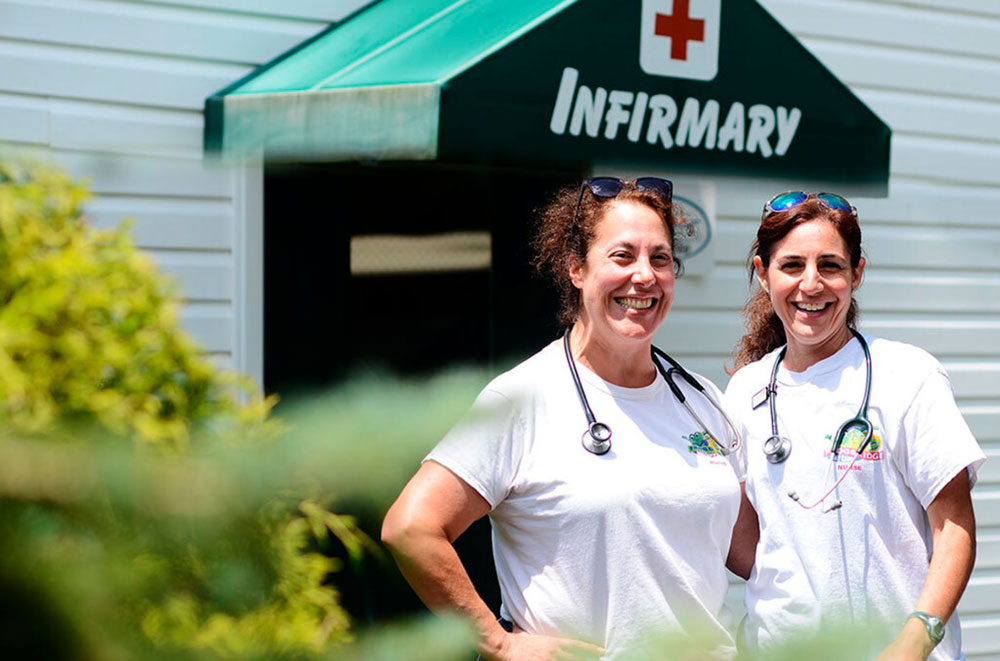
Medication management. If your child takes medication, ask exactly how the camp’s health center handles administration, timing, and communication with you if a dose is missed or a concern comes up.
Communication with parents. Ask how (and how often) staff will update you during the session, and what the process looks like if your child is struggling and the camp needs to problem-solve together with you.
Questions to Ask Before Enrolling
- How many campers with ADHD or autism has your camp supported, and what does a typical accommodation plan look like?
- What specific training do counselors receive beyond general staff training?
- What’s your plan if my child becomes overwhelmed or dysregulated during an activity?
- Can we do a pre-camp call or visit to build a support plan together?
- What does a typical bunk/cabin group size and staff ratio look like for my child’s age?
- How do you handle communication with families during the session, and what’s your escalation process if something isn’t working?
Camps that answer these questions specifically and confidently — rather than with vague reassurances — are usually the ones with real, practiced experience supporting neurodivergent campers. Which Questions Should I Ask About Camp Safety? covers additional safety-specific questions worth layering on top of these.
The Case for Camp, Even When It Feels Like a Stretch
Camp offers real, specific benefits for many neurodivergent kids: a structured social environment to practice peer interaction, physical activity and outdoor time, and a chance to build independence and confidence away from the routines (and sometimes the low expectations) of home and school. Many parents find that camp becomes one of the few environments where their child gets to be seen as fully capable, rather than defined by a diagnosis. That said, the wrong camp — one that’s not equipped to support your child’s specific needs — can also be a genuinely difficult experience, which is exactly why the vetting process matters more here than for a general “any camp will do” decision. How Do Camps Handle Homesickness or Mental Health? is also worth reading, since many of the same emotional-support strategies camps use for homesickness apply directly to supporting neurodivergent campers through a tough moment.
Preparing Your Child (and the Camp) for a Successful Summer
Once you’ve chosen a camp, a little preparation goes a long way:
Share detailed, specific information — not just a diagnosis label. Rather than simply noting “ADHD” or “autism” on a health form, give the camp specifics: what helps your child self-regulate, what tends to trigger dysregulation, and what a good day versus a hard day looks like for them. The more concrete the information, the better staff can actually use it.
Pack familiar comfort and sensory items. A favorite fidget tool, noise-reducing headphones, or a familiar stuffed animal can make a real difference in a new environment. Confirm with the camp ahead of time what’s allowed.
Practice relevant routines beforehand. If your child will need to manage their own medication schedule, pack their own bag, or navigate a new bathroom routine, practicing at home in the weeks before camp can smooth the transition.
Set realistic expectations together. Talk openly with your child about what to expect, including that some adjustment is normal, and that it’s okay to ask a counselor for help when something feels hard.
Establish a communication check-in with staff. Ask when you can expect your first update, and make sure you have a direct contact if you need to reach the camp with a question mid-session.
Frequently Asked Questions
Are there summer camps specifically for kids with ADHD?
Yes. Specialized programs exist that are built specifically around ADHD (and often co-occurring conditions like learning disabilities), typically with smaller group sizes, more structure, and staff trained specifically in ADHD-related strategies.
Can autistic kids go to a regular (mainstream) summer camp?
Many can, especially with a mainstream camp that offers a real inclusion program — dedicated support staff, an individualized plan, and staff trained in autism-specific strategies. The key is verifying the camp’s actual experience and support infrastructure, not just its willingness to enroll your child.
What should I ask a camp about supporting my neurodivergent child?
Ask about staff training specific to your child’s needs, camper-to-staff ratios, how sensory triggers and dysregulation are handled, medication management, and how often you’ll hear from staff during the session.
Is a specialized camp always better than a mainstream camp with inclusion support?
Not necessarily — it depends on your child. A highly structured specialized camp may suit a child who’s easily overwhelmed by a big, less predictable environment, while a well-supported mainstream camp may better suit a child who wants the broader traditional camp experience with the right accommodations layered in.
How early should I start looking into camps for my neurodivergent child?
As early as possible. Camps with strong inclusion or specialized programs often have limited space in their most experienced bunks/groups, and building a real support plan takes time and communication well before opening day.
Will my child’s IEP or 504 plan transfer to a summer camp?
Not automatically — camps aren’t schools and aren’t bound by an IEP or 504 plan in the same legal sense, but sharing the document with a camp gives staff valuable, specific insight into what accommodations have worked well for your child in a structured setting, and most camps welcome that information as part of building their own camp-specific support plan.
Find a Camp That’s the Right Fit
Every family’s needs are different, which is why comparing real programs — and asking the right questions directly — matters more than any generic “best of” list. Search ASC’s camp directory to explore program options, or visit our Future Campers hub for more guidance on finding the right fit for your child.
